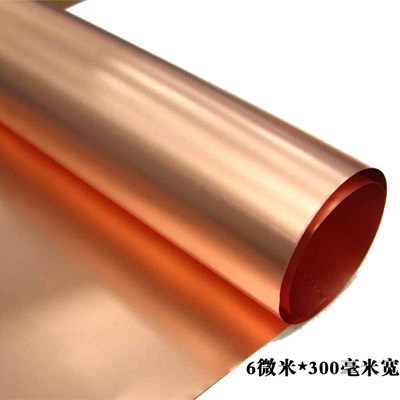
Anqing optimized antistatic copper foil processing
Copper foil can be divided into calendered copper foil and electrolytic copper foil, which are mainly used for flexible printed circuits and other special purposes. In the production of clad laminates, a large number of applications are. As for the purity of copper, IEC-249-34 and Chinese standards stipulate that it shall not be lower than 99.8%.
Anqing optimized antistatic copper foil processing
In order to avoid the copper oxide powder falling off and moving to the substrate, the surface treatment method has also been constantly improved. For example, TW copper foil is coated with a thin layer of zinc on the roughened surface of the copper foil, and the surface is gray; TC type copper foil is coated with a thin layer of copper zinc alloy on the roughened surface of the copper foil. At this time, the surface of the copper foil is golden yellow. After special treatment, the thermal discoloration resistance, oxidation resistance and cyanide resistance of copper foil in PCB manufacturing are improved accordingly.
Anqing optimized antistatic copper foil processing
Copper foil is divided into calendered copper foil and electrolytic copper foil according to the preparation process, which accounts for the vast majority of the market. According to the Copper Foil Branch of China Electricity Association (CCFA), at present, domestic manufacturers mainly focus on the production of electrolytic copper foil. In 19 years, the domestic production capacity of electrolytic copper foil is expected to be close to 600000 tons, while that of rolled copper foil is only about 10000 tons.
Anqing optimized antistatic copper foil processing
Most copper foils used for domestic printed boards are 35um thick, and 50um copper foils are used as transition products. In high-precision hole metallized double-sided or multilayer board manufacturing, thinner than 35um copper foils, such as 18um, 9um and 5um copper foils, are expected. Some multilayer boards use thicker copper foil, such as 70um.
Anqing optimized antistatic copper foil processing
The adhesives used for the laminates mainly include phenolic, epoxy, polyester, polyimide, polytetrafluoroethylene resin, etc. Therefore, the laminates are also divided into phenolic, epoxy, polyester, polyimide, and polytetrafluoroethylene laminates.